
Empire Builder vs. Railroad King: The Battle That Nearly Crashed Wall Street
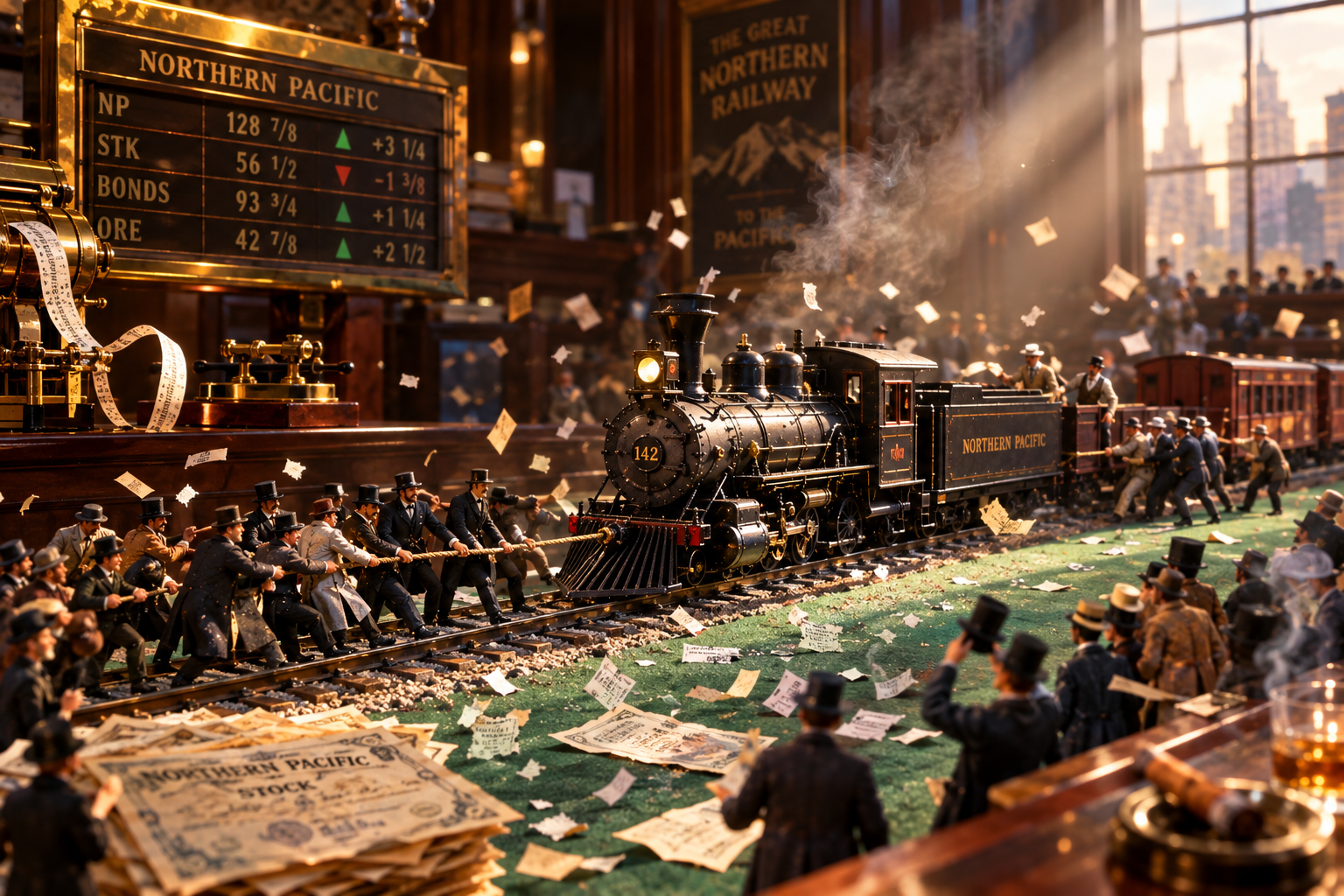
Most of the tales I set down out here end with snow, or with a canyon, or with a man walking alone through country that did not want him. This one ends in a room on Wall Street with the ticker running four hours late, and I want you to understand something before I start: it is the same war. The rails that James Hill and Ned Harriman fought over in the Deschutes Canyon with dynamite and shotguns, they also fought over in New York with certificates of stock. The second fight nearly took the country's money down with it.
You know Hill already. The one-eyed Canadian who built the Great Northern to salt water on his own money and never went broke doing it. By 1901 he had the Great Northern and, with J. P. Morgan standing behind him, effective run of the Northern Pacific besides. Two transcontinentals across the top of the map, and a problem: neither of them reached Chicago. All that wheat and lumber came east to the Twin Cities and then had to be handed to somebody else's railroad to finish the trip.
The Road to Chicago
So in the spring of 1901 Hill went and bought the answer. The Chicago, Burlington and Quincy, some eight thousand miles of good midwestern iron running straight into the stockyards city, purchased for the Great Northern and the Northern Pacific to hold between them. It was a fine piece of work and Hill was pleased with himself.
Edward H. Harriman was not pleased. Harriman ran the Union Pacific, and the Union Pacific wanted the Burlington every bit as bad, for reasons any man with a map could see. He came to Morgan's people and asked, plain enough, for a third of the purchase. He was told no. Now, a smaller man takes no for an answer and goes home. Harriman had Jacob Schiff of Kuhn, Loeb and Company behind him and a different notion entirely.
If they would not sell him a third of the Burlington, he would simply buy the railroad that owned it.
That was the whole of the scheme, and it was audacious. Through late April and into May, Harriman's brokers went quietly into the open market and bought Northern Pacific stock by the tens of millions of dollars, common and preferred both, buying up Hill's own railroad out from under him a few thousand shares at a time. And Hill did not know. He was out in Seattle looking at his docks. Morgan was across the ocean taking the waters in France.
Nine Days in May
Hill found out the way men found out things in those years: he noticed the stock moving and could not account for it. He went east on a special train, fast as the iron would carry him, and by the first days of May the thing was out in the open. Morgan, cabled in France, ordered a hundred and fifty thousand shares bought at the market, whatever the market happened to be.
Which is how you get two of the richest operations on earth bidding against each other for the same finite pile of paper. Northern Pacific had been changing hands around a hundred and ten dollars in April. It went to a hundred and thirty, then a hundred and fifty, then a hundred and eighty on the eighth of May.
And here is where the ordinary folks got hurt, which is the part of the story that matters. Watching a stock triple in three weeks, a great many speculators concluded it had gone mad and sold it short, promising to deliver shares they did not own at a price they were sure would come down. It did not come down. Between Harriman and Morgan, near enough every loose share of Northern Pacific in the world had already been locked in a vault. On the morning of May 9, 1901, the shorts had to deliver, and there was nothing to deliver with.
Northern Pacific opened, went past four hundred within the hour, seven hundred by noon, and touched a thousand dollars a share in the afternoon. Men who had sold it at a hundred and eighty sold everything else they owned in the world, at any price offered, to raise the cash to cover. So the rest of the market fell out from under itself while one stock went to the moon. Thousands of small investors were wiped clean in a single session.
The two biggest houses in America had cornered a railroad by accident, and the corner was strangling everybody standing near it.
They knew it too. That evening the Morgan bank and Kuhn, Loeb called a truce: no more buying for their own accounts, and the shorts could settle up at a hundred and fifty dollars a share instead of a thousand. It was mercy of a sort, and it was self-interest, because a general panic would have cost the winners more than the railroad was worth.
What the Truce Cost Them
Neither man had won. Harriman had spent a fortune and come up just short of control. Hill had kept the Burlington but had been shown, in front of everybody, that his railroad could be bought out from under him on a quiet Tuesday. So they did what tired giants do. They made a treaty.
In November of 1901 they chartered the Northern Securities Company in New Jersey, a holding company capitalized at four hundred million dollars, into which went the Great Northern, the Northern Pacific, and the Burlington. Hill ran it, Morgan and Harriman both sat inside it, and the fighting stopped because there was no longer anything to fight about. From the Twin Cities to Puget Sound, one company now held the lot.
That was the mistake. A president named Theodore Roosevelt had come into office two months earlier, and he looked at that arrangement and saw a combination in restraint of trade. In March of 1902 his Justice Department sued under the Sherman Act, and in March of 1904 the Supreme Court agreed, five to four, and ordered Northern Securities taken apart.
So the fight in the canyon and the fight on the exchange came to the same end, which is the moral of the thing if a tale needs one. Two men wanted the same road badly enough to burn a great deal of other people's money getting at it, and when at last they stopped fighting and shook hands, the government decided the handshake was worse than the war.
What Really Happened
In spring 1901 James J. Hill, backed by J. P. Morgan, bought control of the Chicago, Burlington & Quincy Railroad for the Great Northern and Northern Pacific. Edward H. Harriman of the Union Pacific, refused a share in the purchase, moved with Jacob Schiff of Kuhn, Loeb & Co. to buy control of the Northern Pacific itself on the open market. The competing buying by the Harriman and Morgan camps left almost no floating shares.
On May 9, 1901, short sellers unable to obtain stock for delivery drove Northern Pacific to a high of $1,000 a share, up from roughly $110 in April and about $180 the previous day. Shorts liquidating other positions to raise cash triggered a broad one-day collapse in the rest of the market, the Panic of 1901, ruining many small investors. Morgan and Kuhn, Loeb then agreed to a truce and let the shorts settle at $150 a share.
The combatants formed the Northern Securities Company, chartered in New Jersey in November 1901 and capitalized at $400 million, holding the Great Northern, Northern Pacific, and Burlington. The Roosevelt administration sued under the Sherman Antitrust Act in March 1902; the Supreme Court ruled 5-4 against the company on March 14, 1904, and ordered it dissolved. Figures vary slightly between sources (settlement prices of $150 and $160 both appear in the record). The frontier dialect and the lantern-keeper framing above are storytelling; the dates, prices, and outcomes are drawn from the historical record.