
The Deschutes Canyon Railroad War: Dynamite, Sabotage, and the Last Great Railroad Battle
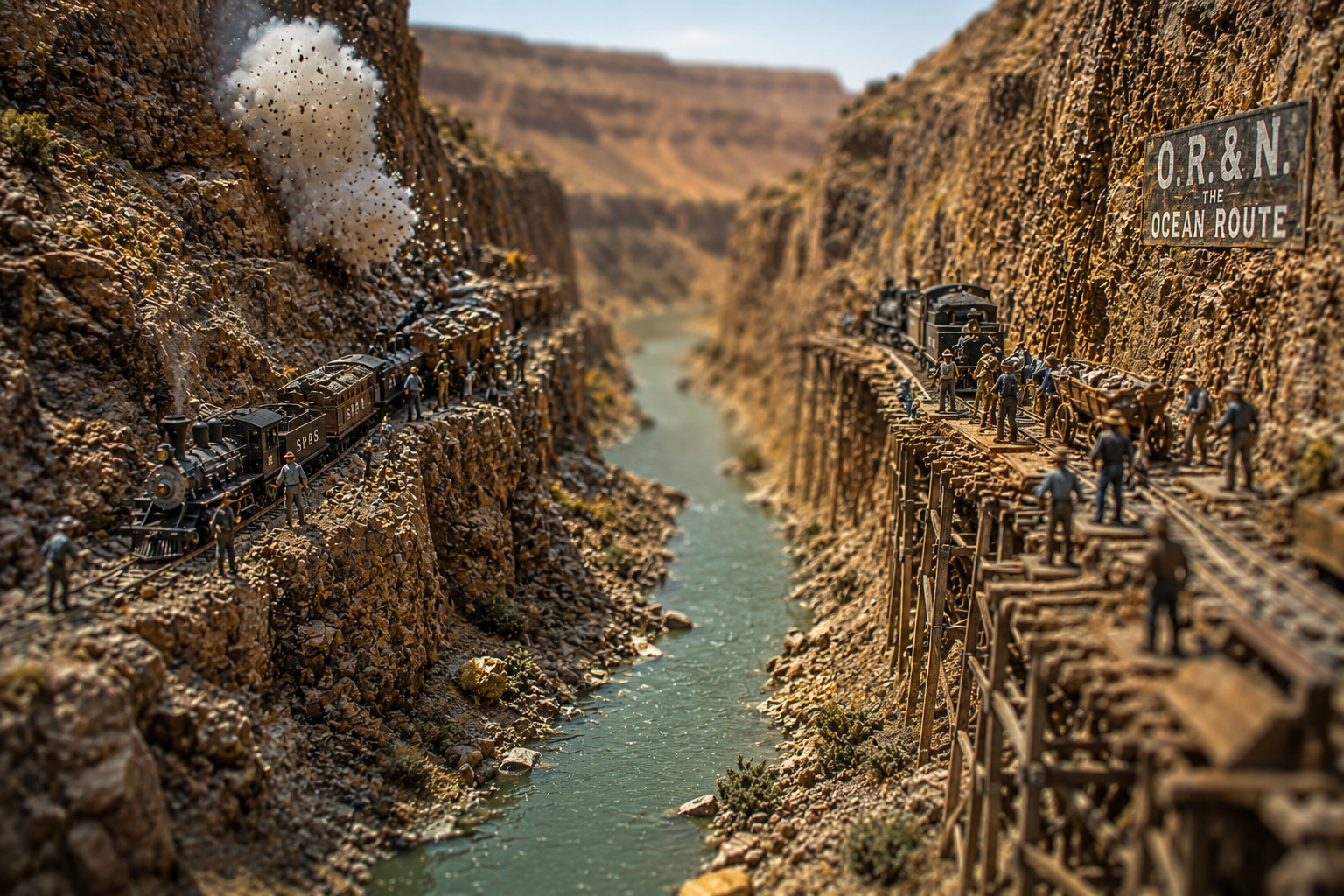
In the summer of 1909, James J. Hill and E.H. Harriman had a problem that two of the richest men in America were uniquely qualified to solve by making it somebody else's problem. Both men wanted central Oregon. Specifically, both wanted the Deschutes Canyon (the one viable route south from the Columbia River into the high desert interior) and neither was willing to let the other have it. Hill controlled the Great Northern and Northern Pacific. Harriman ran the Union Pacific and Southern Pacific. Between those two empires lay a stretch of Oregon river canyon barely wide enough for a single set of tracks on each bank. They decided to build those tracks simultaneously, on opposite sides of the same river, at the same time. What followed became known as the last great railroad-building race in the American West, and it got violent faster than anyone officially admitted.
Two Armies, One Canyon
Harriman had seen this coming. He incorporated the Des Chutes Railroad in 1906 (note the spelling, a deliberate distinction from the river) and began surveying the eastern bank before Hill had even formally committed to the route. Hill responded by chartering the Oregon Trunk Railway and assigning his best engineer, John F. Stevens, to the western bank. Stevens was the man who had nearly frozen to death discovering Marias Pass in Montana and then gone on to build the Great Northern's original Cascade Tunnel. He was not someone who got rattled by a canyon.
By the summer of 1909, construction was fully underway on both sides. Hill's crews worked west of the Deschutes River. Harriman's crews worked east. By October, nearly 2,000 workers occupied the canyon, living in rival camps separated by the river and a level of mutual hostility that a Prineville newspaper, with some understatement, described as "the Titanic Struggle for Possession of the Deschutes." The canyon, which was already difficult enough (steep walls, narrow ledges, terrain that required multiple wooden trestle bridges and hand-carved tunnels), became something that looked, from a distance, like an industrial battlefield.
It looked that way because it was.
Sharpshooters, Moonshine, and a Sheriff Without a Horse
The violence wasn't dramatic in the frontier-movie sense. It was smaller and meaner. Workers from rival crews met on the narrow canyon trails and settled arguments about right-of-way with shovels, crowbars, and pick handles. Men stationed themselves on ledges above rival work sites, watching for targets to wander into the open. Supply wagons found their paths blocked by boulders that had appeared overnight. Those same wagons got sabotaged in the dark: wheels loosened, axles weakened, cargo destroyed. After dark, fueled by moonshine from camp stores, crews would conduct raids on the other side's black powder supplies, either stealing the explosives or destroying them outright. Potshots echoed through the canyon at dusk with enough regularity that neither side could pretend it wasn't happening.
By October 1909, the Deschutes Canyon had become the most deliberately dangerous construction site in America: 2,000 men working in a place barely wide enough for two railroads, separated by a river and consumed by a rivalry that neither railroad company officially acknowledged and neither work crew could ignore.
The moment that came closest to open warfare involved water. John F. Stevens, ever the strategist, discovered that his side of the canyon held the only reliable water source in a particular section of the route. Without water, a construction camp cannot function: you cannot lay rail, operate machinery, or keep men alive in the high desert heat. Stevens purchased the property containing that water source, posted "No Trespassing" signs, and stationed armed guards. When Harriman's crews tried to access the water anyway, tensions climbed to the point where the local sheriff drove out to resolve the situation. The confrontation that followed resulted in a fistfight between the Porter Brothers' crew (Hill's contractors) and the Twohy Brothers' crew (Harriman's contractors), the sheriff's attempt to restore order collapsing completely, and his horses bolting into the high desert, leaving the lawman standing in the canyon floor without transportation and without authority over anything happening around him. The state of Oregon had effectively been evicted from its own canyon by two railroad companies.
Death Changes the Math
E.H. Harriman died on September 9, 1909. He was sixty-one years old and had been fighting stomach cancer through much of the conflict, though that detail didn't slow him down much while he was alive. His death transformed the entire situation in ways that dynamite and sharpshooters hadn't managed to. Robert S. Lovett, who inherited management of Harriman's railroad operations, was a negotiator rather than a warrior. He looked at the Deschutes Canyon situation, two railroads spending enormous sums to build parallel lines through terrain that barely had room for one, and saw what Harriman had refused to see: an argument for cooperation.
By May 1910, Lovett and Hill had reached an agreement. It was elegant in the way that expensive compromises tend to be. They divided the canyon between them. Hill's Oregon Trunk would operate the tracks from North Junction to South Junction (10.4 miles) and from Metolius to Bend, another 42.6 miles. Harriman's Des Chutes Railroad would operate South Junction to Metolius, 24 miles. Each railroad would use the other's track in their respective sections. The canyon they had nearly torn apart to possess would be jointly managed, shared infrastructure replacing the shared battlefield.
On November 1, 1911, passenger service opened to Bend. The race was over. The last great railroad-building war in the American West ended not with a victory for either side, but with a handshake between two men, one of whom hadn't started the fight, who understood that a working railroad was worth more than a winning argument.
What the Canyon Kept
The rails still run through the Deschutes Canyon today. Both sets of tracks, on both banks of the river, following nearly the same path carved out by those 2,000 workers in 1909 and 1910. The Crooked River Bridge still crosses its 320-foot-deep gorge, 350 feet of span over a chasm that required some of the most careful engineering of the entire project. If you drive through central Oregon and catch sight of those parallel railroads hugging the canyon walls, you're looking at the physical record of a time when industrial competition operated at a scale and intensity that had almost nothing in common with normal business, and everything in common with the way empires actually get built.
Hill and Harriman never settled their rivalry. One of them died before the canyon conflict was resolved. But the canyon outlasted both of them, carrying freight that neither man controlled, through terrain that both of them bled over, on tracks laid by workers most of them never knew. The Deschutes still runs. The trains still follow it south. The sheriff's horses presumably found their own way home.
Sources & Further Reading:
- Railroads into Central Oregon, Oregon History Project
- The Deschutes Railroad War - Bend Magazine
- Railroad Wars - Wikipedia
- James J. Hill - Oregon Encyclopedia
- Oregon Trunk Railway - Wikipedia
Written by Kevin Sotka for meatbagmade.com. Got a favorite railroad story? Drop me a line at meatbagmade@gmail.com or find me on X/Twitter at @TrainDewd. Subscribe to the newsletter on Substack for more Pacific Northwest railroad history.