
The One-Eyed Empire Builder: James J. Hill and the Railroad That Never Went Broke
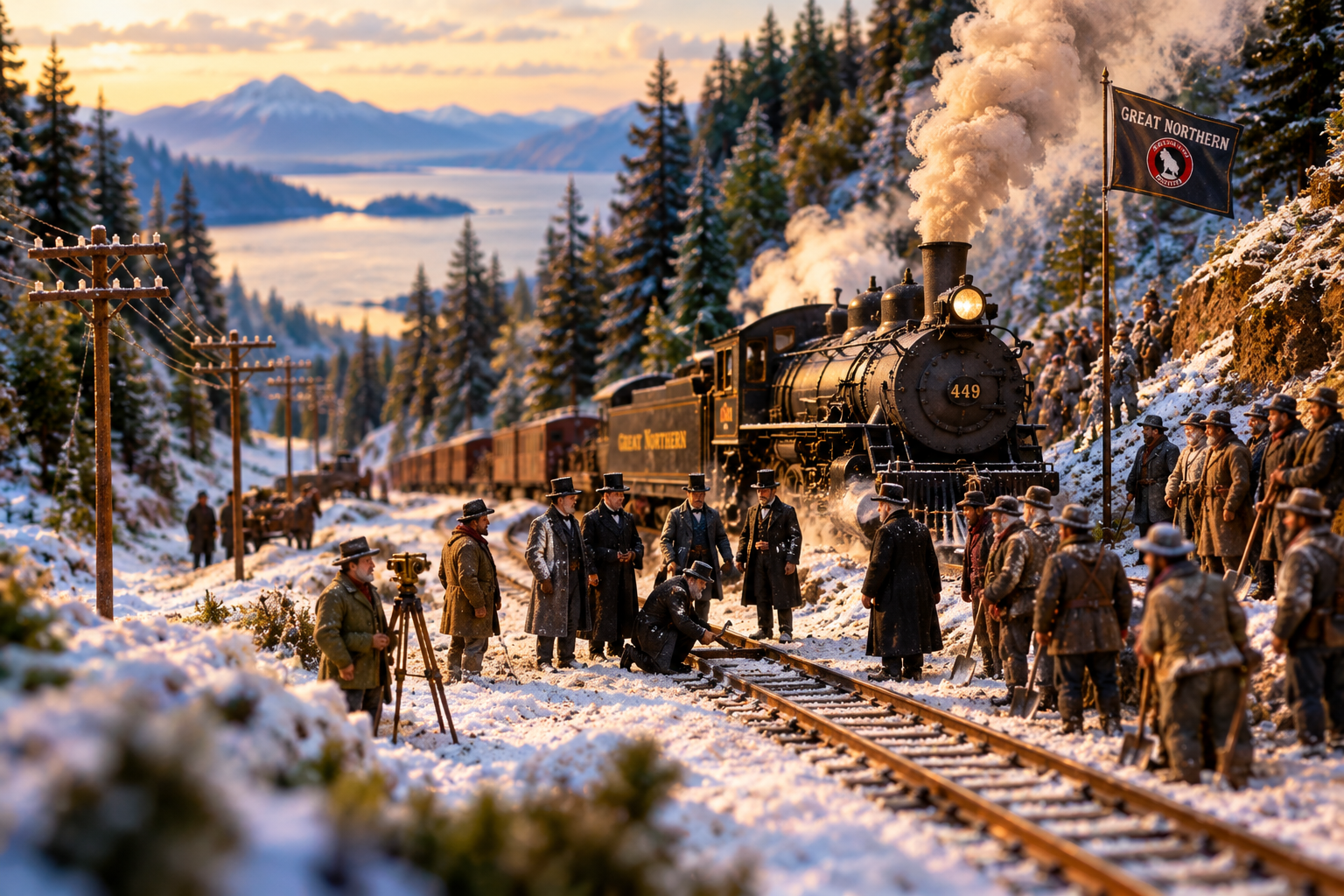
I have told you about the men who did the dying on this railroad. The section hands buried in the cut at Rogers Pass. The ninety-six the mountain shrugged off the ledge at Wellington. The engineer walking the Marias summit all night in forty below because sitting down meant never standing up again. Now let me tell you about the man they were all working for, because you cannot understand the high iron of this country without understanding him, and you cannot understand him at all if you only think of him as a rich man.
He was born in a log house in Upper Canada, September of 1838, in a county called Wellington, which is a coincidence I have never quite made peace with. Farm boy. Wanted to be a doctor. Then two things happened that closed that door: a boyhood accident took the sight out of one of his eyes, and his father died and left the family with nothing to spare for schooling a physician. So he came down to St. Paul in 1856, eighteen years old and half blind, and took work as a clerk on the steamboat levee, writing down other men's freight.
He spent his youth counting somebody else's cargo. He spent the rest of his life making certain it was his.
The Bankrupt Railroad Nobody Wanted
Here is where the tale turns, and it turns on a wreck. In 1878 there was a busted little outfit called the St. Paul and Pacific, laid across Minnesota and gone belly-up in the panic of '73 the way half the railroads in the country had. Rusting iron, sinking grade, no money. The kind of property a sensible man walks past. Hill and a few partners took it up out of the dirt.
And what he did with it is the whole secret, so hear it plain. He did not lay a mile of track west until the mile behind it was paying. He rebuilt what he had before he reached for what he did not. He sold the farmland along his line to immigrant families, Germans and Scandinavians mostly, brought them out and settled them on it, and then hauled their wheat to market on his own rails. Other men built railroads to sell stock. Hill built a railroad to have a railroad, and he built the country alongside it so the railroad would have something to carry.
In 1889 he renamed the thing the Great Northern Railway and turned its nose toward the Pacific. The newspapers took one look at a private man laying a transcontinental line through empty northern country on his own dime and called it Hill's Folly.
Without a Nickel of the Public's Money
Now understand what everybody else had done. The Union Pacific, the Central Pacific, the Northern Pacific: they were built on federal land grants and public credit, great checkerboards of the national domain signed over to get the rails laid. That was the arrangement of the age, and there is no shame in it. But the Great Northern was pushed to salt water essentially without it, and that is the fact that makes Hill peculiar in the whole history of American railroading. No public trough. He paid for his own iron.
Which meant he could not afford a bad grade. A land-grant road could take a wretched alignment and make the loss up in acreage. Hill's road had to earn back every foot of it in freight, forever. That is why he sent John F. Stevens hunting the lost pass through the Rockies in the dead of a Montana December, and it is why Marias Pass at 5,214 feet was worth walking a man half to death for. A gentle crossing was money in the bank every day for a hundred years.
The Cascades he could not solve so cleanly, not at first. He got over Stevens Pass on a fearful set of switchbacks, zigzagging his trains up the mountain like a man tacking a sailboat, and then bored under the worst of it. The last spike went down at Scenic, Washington, on the sixth of January, 1893, and the line ran into Seattle the next day.
The Year Everything Else Fell Down
He finished not one season too soon. That very year the Panic of 1893 came through the country like a slide through a snowshed, and the railroads went down in rows. The Northern Pacific went under. The Union Pacific went under. The Santa Fe went under. Roads that had been built on paper collapsed when the paper stopped being worth anything.
The Great Northern stayed up. It is the only one of the northern transcontinentals that never went into receivership, not in the '93 panic and not after, and that is not luck. That is what you get when a man refuses to lay track ahead of the traffic. Hill picked the wreckage over afterward and took a controlling hand in the Northern Pacific he had just outlived, which is how, eight years later, he ended up in the Wall Street brawl that sent Northern Pacific stock to a thousand dollars a share and scared the daylights out of the country. But that is another night's tale.
He held the reins until he died, the twenty-ninth of May, 1916, worth something like sixty-three million dollars of his own. And here is the thing that ought to sit with you: his road outlasted him by a long stretch, the passenger train they named for him still runs the northern route today, and the mountains he beat with a cheap grade and a hard head are the same mountains that took all those men I have told you about. He built the best-run railroad on the continent, and it still could not keep the snow off the track. Both of those are true. A tale is not honest unless it carries the two of them together.
What Really Happened
James Jerome Hill was born September 16, 1838, in Rockwood, Upper Canada (later Ontario). He lost the sight of one eye in a boyhood accident, and his father's death ended his plan to study medicine. He arrived in St. Paul, Minnesota, in 1856 and worked as a shipping clerk on the river levee.
In 1878 Hill and his associates acquired the bankrupt St. Paul and Pacific Railroad, which was reorganized and renamed the Great Northern Railway in 1889. Hill's strategy was incremental: extend west only as far as existing traffic could pay for, and settle immigrant farmers (largely German and Scandinavian) along the line to generate freight. Critics called the western extension "Hill's Folly."
The Great Northern crossed the Rockies at Marias Pass (5,214 feet), located for Hill by engineer John F. Stevens in December 1889, and initially crossed the Cascades on switchbacks at Stevens Pass. The last spike was driven at Scenic, Washington, on January 6, 1893, and the line reached Seattle on January 7, 1893.
The Great Northern is generally cited as the only northern transcontinental completed essentially without federal land grants or public subsidy, and the only one that never went bankrupt. It survived the Panic of 1893, which drove the Northern Pacific, Union Pacific, and Santa Fe into receivership. Hill remained active in his companies until his death on May 29, 1916; his personal fortune was estimated at roughly $63 million. Great Northern's flagship passenger train, the Empire Builder, was named for him in 1929 and still operates under Amtrak.
The frontier dialect and lantern-keeper framing above are storytelling. The dates, figures, routes, and outcomes are drawn from the historical record.