
The Switchback Era: When Trains Traveled 13 Miles to Move 3
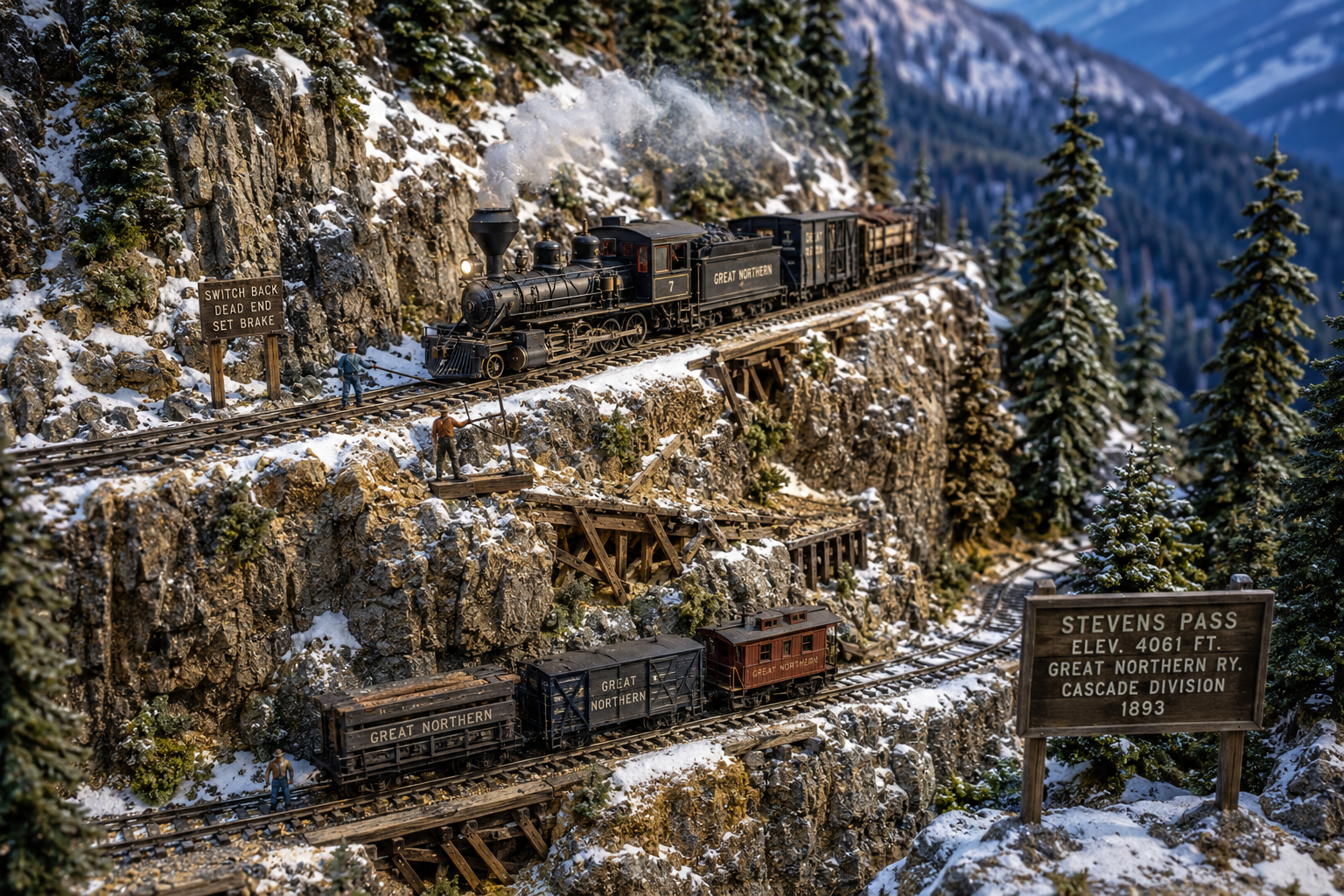
Pull your chair up to the stove and I'll tell you about the years before the mountain had a hole in it. These days the Great Northern trains slide clean through the Cascades in the dark of the tunnel and never so much as tip their hats to the summit. But there was a time, and not so long ago as you'd think, when there was no tunnel at all. When a train wanting to cross Stevens Pass had to climb the bare face of the mountain the hard way, in the open weather, on a contraption of track so ornery that it took thirteen miles of rail to move a train three miles forward. They called them the switchbacks, and the men who ran them called them a good deal worse.
Here is the trouble the Great Northern faced in 1893. James Hill wanted his railroad to Puget Sound and he wanted it that year, tunnel or no tunnel. A proper bore through the mountain would take years the railroad didn't care to wait. So the engineer, a self-taught fellow by the name of John Frank Stevens (the same Stevens who'd walked alone all night on Marias Pass to keep from freezing, if you recall that tale), laid out a temporary line to get the trains over the top while the real work waited. Temporary, he called it. It lasted seven winters, and every one of them tried to kill somebody.
Thirteen Miles to Gain Three
Now, a mountain doesn't care how badly a railroad wants to climb it. The grade Stevens needed was far too steep to take head-on, so he did the only thing the terrain allowed: he zigzagged. Eight switchbacks in all, three of them on the gentler eastern slope and five on the steeper west side, each one a stub of track maybe a thousand feet long ending in a dead-end spur. A train would run up one leg as far as it went, stop dead, throw the switch behind it, and then back up the next leg in reverse. Then stop, throw the switch, and go forward again. Up and up, forward and back, like a man climbing a ladder by walking the full length of every rung. By the time you crossed the summit you were riding backward, and you'd laid down thirteen miles of travel to gain three as the crow flies.
Forward, then back, then forward again, gaining the mountain a rung at a time, until the whole train went over the top of the world running the wrong way round.
And it was steep even so. On the west slope the grade ran to a full four percent, which is about as much as an iron wheel on an iron rail can bear before it simply gives up and slides. The curves were wicked, twelve degrees and tighter, so sharp the couplings groaned. On a fair summer day, with dry rail and a good head of steam, a train might crest the whole ladder in an hour and a quarter. That was the good day.
The Bad Days, Which Were Most of Them
The bad days came with the snow, and up on Stevens Pass the snow came like nothing the flatland ever sees. Eight inches an hour was ordinary. A foot an hour was nothing to remark on. It drifted seventy-five feet deep in the cuts, deeper than a five-story building, and it came down on those open switchbacks with nothing between the weather and the passengers but the roof of the coach. A trip that took ninety minutes in July could take a day and a half in February, the train inching between walls of white while the rotary plows fought ahead of it and the crews shoveled behind.
Think on what that meant for the poor souls in the cars. You'd bought a ticket to Seattle and found yourself stalled on a dead-end spur halfway up a mountain, the wind screaming, the snow rising past the windows, the whole train hitched to a slope where every ounce of loaded weight was one skidded wheel away from running off backward into the timber. The switchbacks were slow, and slow on that mountain in that weather was another word for dangerous. Every winter the railroad held its breath, and every winter the pass took its due in frostbite and fear and the occasional man who didn't come down.
Answering the Mountain
Hill and his engineers knew the ladder was no way to run a railroad, and they never pretended otherwise. Even as the first trains were backing over the summit in 1893, the plan was already to go through the rock instead of over it. They started boring the first Cascade Tunnel in the summer of 1897 and drove it through by the tail end of 1900, near two and two-thirds miles of it, and the day it opened the switchbacks fell silent. The tunnel dropped the summit of the line by near seven hundred feet and did away with the four-percent ladder for good. No more backing over the top. No more thirteen miles to gain three.
But the mountain, you understand, was not so easily answered. That first tunnel put the trains lower, and lower on Stevens Pass is where the avalanches run. Ten years after the switchbacks went quiet, at a place called Wellington just outside the west portal of that very tunnel, the snow came down on two waiting trains and took ninety-six souls in a single night. It took a second tunnel, longer and lower still, opened in 1929, to finally beat the pass. So the switchbacks were only the first answer, and a poor one, in a long argument between a railroad and a mountain that ran the better part of forty years.
If you want to see them now, you can. The old grade with its zigzag stubs still climbs the hillside above the highway, and folks walk it in summer under the name of the Iron Goat Trail, treading the very shelf where the trains once backed over the roof of the Cascades. Stand up there in the quiet and you'd never guess what a racket it once took to get a train across. Thirteen miles to move three, and glad of every one of them.
What Really Happened
The Great Northern Railway's original crossing of Stevens Pass opened in early 1893 (the final spike was driven January 6, 1893) as a temporary switchback route engineered by John F. Stevens while the first Cascade Tunnel was planned. It used eight switchbacks, three on the eastern slope and five on the steeper western slope, requiring roughly 13 miles of track to advance about 3 miles. Grades reached about 4 percent on the west side with curves as sharp as 12 degrees, and trains reversed direction repeatedly, ultimately backing over the summit at an elevation above 4,000 feet.
A good crossing took about 75 minutes; in heavy winter snow it could take up to 36 hours, with snowfall of 8 to 12 inches an hour and drifts reported up to 75 feet. The first Cascade Tunnel (about 2.63 miles) was begun in 1897, completed in 1900, and eliminated the switchbacks, lowering the summit of the line by roughly 685 feet. The abandoned grade is now the Iron Goat Trail, opened in 1993. The lantern-keeper dialect above is storytelling; the dates, grades, switchback count, and figures are drawn from the historical record.