
When the Railroad Came for Yakama Land: Broken Treaties and the Birth of Two Cities
I'll tell you a story with two betrayals in it, thirty years apart, and the same railroad standing behind both. The first one you'd call a war. The second one, folks just called moving day. But pull the thread far enough and you'll find they're tied to the same knot, and the knot is this: a company that wants a right of way will promise you almost anything to get it, and it will keep exactly as much of that promise as the law makes it keep.
The Promise on Ahtanum Creek
Go back to 1853. A young Army captain named George McClellan, the same one who'd later fumble the Union Army half to death in the Civil War, came up the Ahtanum with a survey party, hunting a pass for a railroad that hadn't been built yet and wouldn't be for another thirty years. He sat down with Kamiakin, headman of the Yakama, and Owhi beside him, and he told them plain: this is a survey, nothing more. We are only looking for a line for the railroad to follow. No one means to settle this ground.
Kamiakin didn't believe him. He'd watched enough of the country change hands to know what a surveyor's stake usually meant, and inside a month a wagon train of emigrants rolled into the very valley McClellan had sworn would stay empty. The promise hadn't lasted the season.
He told them it was only a line on a map. The wagon train that proved him wrong was already on the road before his ink was dry.
Two years on, in 1855, Territorial Governor Isaac Stevens sat the Yakama and thirteen other bands down at Walla Walla and had them sign away eleven million acres, folding them all into one new thing called the Yakama Nation and setting them on a fraction of the ground their people had always held. Stevens promised the treaty wouldn't take effect, and settlers wouldn't come, until the Senate in Washington City got around to ratifying it. Miners came anyway, chasing gold strikes up toward the Colville country and across the line into British Columbia, tramping straight through land that was still, by the government's own paper, not yet theirs to walk. That was the spark. The Yakama War opened that October, and by the time it burned out in 1858 the treaty's ink had dried in blood on both sides, and the promise on Ahtanum Creek was long since dust.
Spring Hill Becomes a County Seat
The valley the treaty had opened filled in slow, the way these things do. A wagon train bound for Puget Sound in 1865 took a look at the Yakima River instead of following the long road down the Columbia, and decided they liked what they saw well enough to stop. They called their settlement Spring Hill first. By 1869 it had the name it would carry into the history books: Yakima City. The territorial legislature made it county seat the next year, and the little town kept right on growing, the way a town does when it thinks it's found the winning ground. By the winter of 1884 it had five hundred souls, three churches, a bank, hotels, and the kind of confidence that comes from being the only real town for miles.
What Yakima City did not have, yet, was a railroad. Everything came and went by wagon on roads that turned to soup half the year, and everybody in town knew exactly what a line of steel would be worth to them. Word had been drifting up the valley for a decade that the Northern Pacific meant to build through, and then the Panic of 1873 knocked the company flat on its back and the waiting stretched on for another ten years besides.
The Depot That Went Somewhere Else
The rails finally reached Yakima City on December 17, 1884, and the town met the first freight car with a celebration big enough to empty six barrels of whiskey before the sun went down. They thought they'd won. They found out inside the week that they hadn't.
The Northern Pacific announced its depot wouldn't be built in Yakima City at all. The company had already platted a brand-new townsite four miles north, up the valley, and it was offering free building lots to any Yakima City merchant willing to move there by the first of May. The railroad's men said the old site sat too low and too swampy once irrigation water started running. The town's people had their own theory, and it was a plainer one: a company that owns every lot in a brand-new town owns the town, in a way it never could an established one with its own bank and its own council and its own idea of what a fair freight rate looked like.
Yakima City didn't go quietly. The town offered the railroad half its vacant land outright if the company would just build the depot where the people already were. The Northern Pacific said no. The town got the territorial government to sue, and — this is the part that still surprises people — Yakima City won, first in district court and then again before the territorial supreme court. A company under federal charter, made to put its depot where a town full of paying customers already stood.
It didn't matter. While the lawsuit crawled its slow way up toward Washington City, the Northern Pacific just kept building North Yakima anyway, brick by brick and lot by lot, daring the court to catch up to it. By the time the United States Supreme Court finally ruled, in 1892, there was no longer much of anything left in Yakima City to hand a victory to.
A Town on Rollers
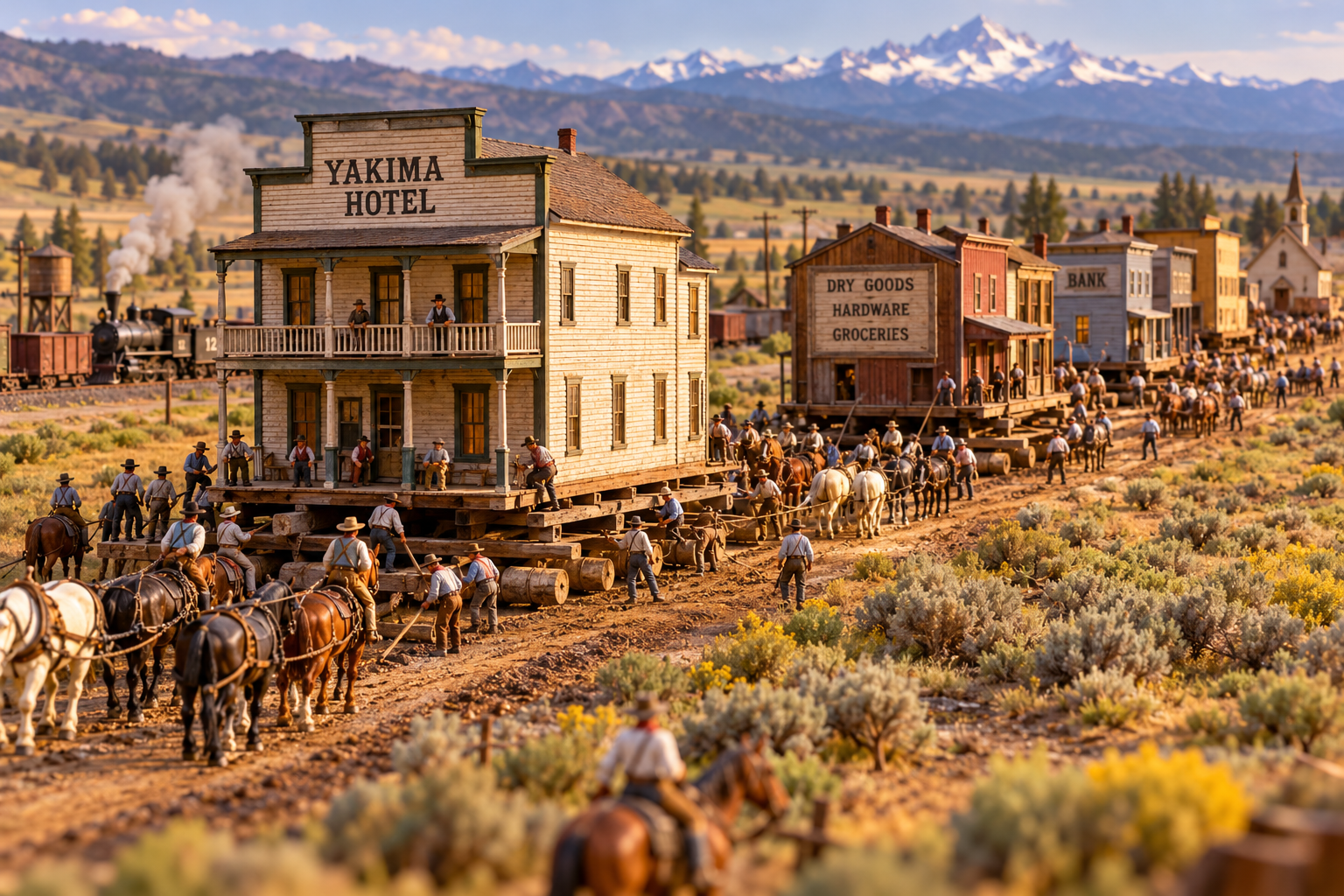
Here's the part I like best, and the part that's true right down to the log rollers. More than a hundred buildings in Yakima City got winched up onto skids and hauled four miles north through the winter and spring of 1884 and 1885, the railroad footing the bill for every foot of it. The Guilland House hotel stayed open through three straight weeks on the road, guests checking in and out of a building that was, at that very moment, being dragged across the valley floor. A bank kept its doors unlocked the whole way.
Not everyone went easy. The Yakima Signal's newspaper office was blown apart with dynamite the night before its own move north, and most folks figured somebody local did it to punish the editor for taking the railroad's offer and, as they saw it, abandoning the fight. And two young girls, whose names the record has kept better than it kept the names at Rogers Pass, walked out along the rails one night and smeared them thick with grease heading north, so the Northern Pacific's own train sat stuck and spinning until the crew scraped the track clean by hand. It didn't save the town. It's still a fine thing to have done.
By 1892, when the high court finally sided with the railroad and ruled that Congress had never actually required a depot at Yakima City, the old town's population had fallen from five hundred to a hundred and fifty. Justice John Marshall Harlan wrote the dissent, and he didn't mince it: there was no good public reason, he said, that Yakima City shouldn't have kept its stop. He was right, and it didn't change a single vote.
Two Names for One Valley
North Yakima took the county seat and never let it go. In 1917 the legislature finally sorted out the paperwork by renaming old Yakima City to Union Gap, and the next year North Yakima dropped its "North" and simply became Yakima, the name it carries yet. Union Gap is still there today, a small city in its own right in the shadow of the ridge that gave it its name, four miles south of the valley's real center of gravity — the town the railroad built to replace it.
The same valley the Northern Pacific fought so hard to control would go on, within another generation, to grow the potatoes that made the line's dining cars famous clear across the country. The company that broke a promise to Kamiakin's people in 1853, and broke a courtroom victory over their heads thirty years later, ended up sitting on some of the richest farmland in the state. That's the trouble with a knot like this one. Follow it far enough back and you find the same hands tying every loop.
What Really Happened
In 1853, Army topographical engineer George B. McClellan led a Pacific railroad survey through the Yakima Valley and assured Yakama leader Kamiakin that no settlement was intended, only a survey. Settlers arrived within weeks regardless. The 1855 Treaty with the Yakama Nation (negotiated by Governor Isaac Stevens) ceded roughly 11 million acres and confederated 14 tribes and bands into the Yakama Nation; violations of its terms, including settler and miner incursions before ratification, helped trigger the Yakima War of 1855–1858.
Separately, decades later: Yakima City (founded 1869, county seat from 1870) was reached by the Northern Pacific Railway on December 17, 1884. The railroad declined to build a depot there and instead platted North Yakima roughly four miles north, offering free lots and moving costs to businesses that relocated by May 1, 1885. Yakima City sued and won in territorial courts, but the Northern Pacific proceeded regardless; the U.S. Supreme Court ultimately ruled for the railroad in 1892 (Justice John Marshall Harlan dissenting), by which point over 100 buildings had already been physically moved to North Yakima and the old town's population had fallen from about 500 to 150. The Yakima Signal newspaper office was destroyed by dynamite rather than moved, and two young women reportedly greased the rails to delay a Northern Pacific train. In 1917–1918, Yakima City was renamed Union Gap and North Yakima was shortened to Yakima. The lantern-keeper's frontier voice above is storytelling; the treaty terms, dates, court history, and casualty/population figures are drawn from the historical record.
Sources & Further Reading
- It Happened Here: Northern Pacific Railway snubs Yakima, creates North Yakima, Yakima Herald-Republic
- Northern Pacific reaches Yakima City, where it declines to build a station, on December 17, 1884, HistoryLink.org
- Yakima — Thumbnail History, HistoryLink.org
- Yakima War, Wikipedia
- Treaty with the Yakama, 1855, Columbia River Inter-Tribal Fish Commission