
The Night They Drove Out Chinatown: Seattle's 1886 Anti-Chinese Riots
I've told you before about the men who laid this railroad's rail, the ones in blue cotton jackets and woven straw hats who cut two-thirds of the Northern Pacific's grade through country that near killed them twice over for wages half a white man's. I never told you what this country did with them once the rail was down and the wage no longer needed spending. This is that tale, and it isn't a proud one. It happened in Seattle, on a wet gray morning in February of 1886, and it had been rehearsed three months earlier, ninety miles south, in Tacoma.
You'd think a depression would teach men to blame the bankers. It rarely does. It teaches them to blame whoever's closest and can't vote, and in the winter of 1885 that was the Chinese laborer, thousands of him, up and down this coast, having finished the grading and the tunneling and moved into the canneries, the hop fields, the laundries, and the coal mines the white unions wanted for themselves.
Tacoma Shows the Way
Tacoma went first, and Tacoma did it in daylight. On the third of November, 1885, the foundry whistles blew at half past nine and several hundred men walked, orderly as a church procession, into the Chinese quarter. They gave every resident, laborers and shopkeepers and whole families both, a few hours to gather what they could carry, then marched some two hundred souls the seven miles to the railroad depot at Lakeview in a cold rain and put them on a train south to Portland. Within days what buildings remained were burned to the ground.
They called it the Tacoma Method, and they said it proud, because nobody had fired a shot and the newspapers back east couldn't find a body to print a photograph of.
That's the ugliest part of the Tacoma story: it worked, and it worked clean enough that other cities took it as a model. No riot, no militia, no dead men in the street. Just several hundred citizens deciding by themselves that a few thousand of their neighbors no longer had a right to live where they lived, and the city fathers standing behind them the whole while.
Seattle Tries It the Hard Way
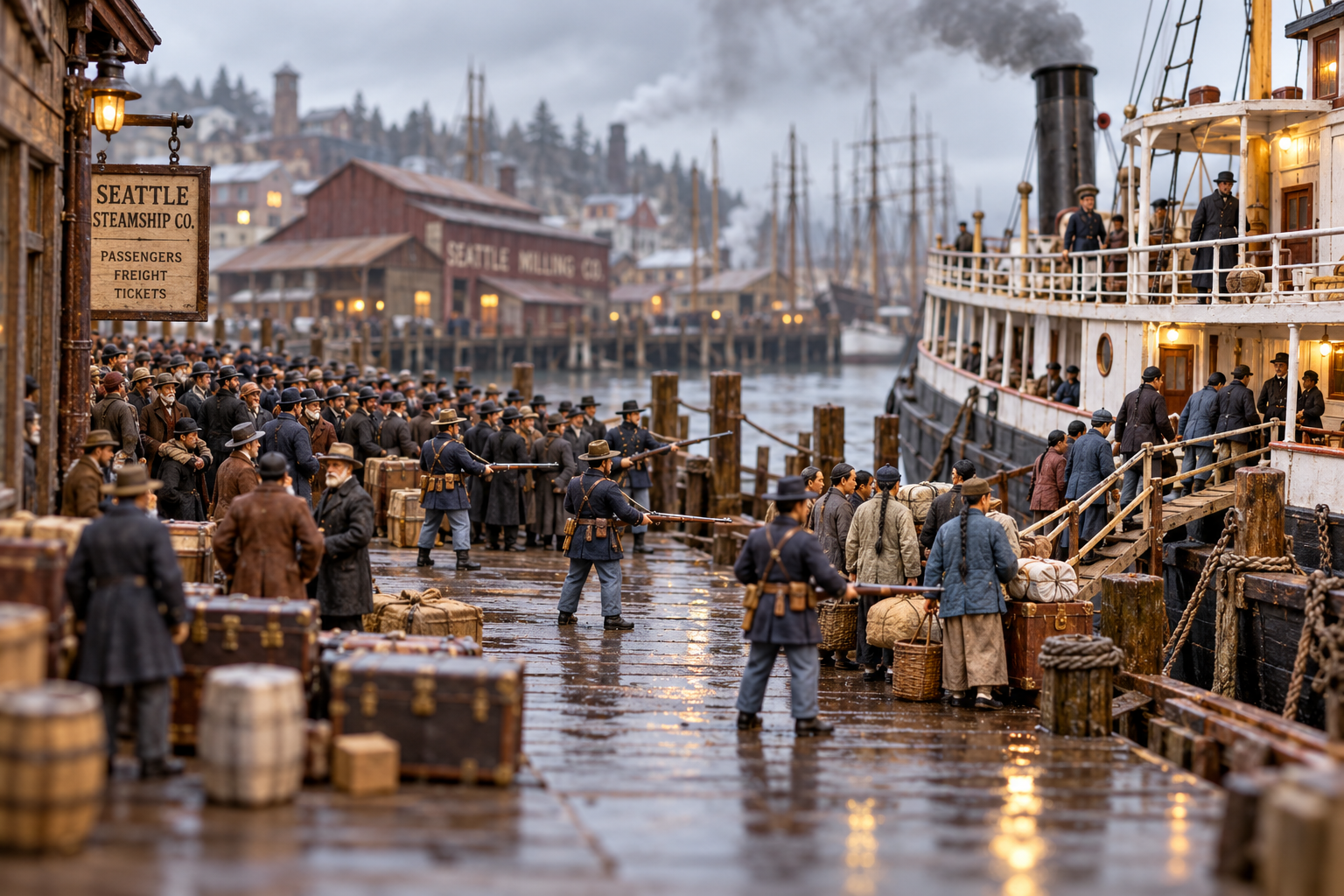
Seattle's Knights of Labor had watched Tacoma and wanted the same result, and on the seventh of February, 1886, they went to get it. A mob that swelled past a thousand, some accounts say fifteen hundred, moved through the Chinese quarter near the Lava Beds south of Pioneer Square, pulled people from their rooms and laundries, loaded them and their belongings onto drays, and hauled roughly three hundred and fifty men and women down to the Ocean Dock to put them aboard the steamer Queen of the Pacific for San Francisco.
Here the story splits from Tacoma's. Seattle had a territorial governor, Watson Squire, who wasn't willing to let a mob run the waterfront, and a company of Home Guard militia who tried to hold the line. The ship's owners wouldn't take passengers who couldn't pay their own fare, which stalled the whole operation overnight with roughly a hundred Chinese residents stranded on the dock in the cold. When a judge ordered that those who wished to stay be escorted back to their homes the next morning, the crowd that had gathered to watch turned into a crowd that wanted to finish what it started. Shots went into the escort. Five rioters went down, and one of them, a laborer named George Reese, died of his wound days later.
Three Hundred Soldiers and a President's Order
That was more blood than Tacoma's method had spent, and it brought Washington into it. The mayor called out every militia company in the city, martial law came down over Seattle for two weeks, and President Grover Cleveland himself ordered federal troops in: eight companies of the 14th Infantry, some three hundred men, marched off the dock from Vancouver Barracks on the tenth of February to hold the peace between a city that couldn't agree whether its Chinese neighbors had a right to stay.
The soldiers didn't reverse what had already happened. Most of the roughly three hundred and fifty who'd been marched to the dock left anyway, some by choice after what they'd seen, some because there was nothing left in the city willing to employ or house them. Seattle's first Chinatown, the one the section gangs and cannery hands had built up over fifteen years, was effectively emptied inside a week, propped back up only slowly, by different hands, in the years after.
What Really Happened
Anti-Chinese violence swept Washington Territory's mill and rail towns amid the depression of the mid-1880s, culminating in the Tacoma riot of November 3, 1885 (roughly 200 Chinese residents forcibly marched to the Lakeview train depot and expelled, with the Chinese quarter later burned) and the Seattle riot of February 7–9, 1886 (a mob of hundreds to roughly 1,500 forcibly rounded up an estimated 350 Chinese residents and attempted to deport them by steamer). Territorial governor Watson Squire and local militia initially resisted the Seattle expulsion; when a mob fired on an escort returning willing residents to their homes on February 9, one rioter, George Reese, was fatally wounded. President Grover Cleveland declared the situation required federal intervention and ordered roughly 300 U.S. Army troops (8th companies of the 14th Infantry) from Vancouver Barracks to Seattle, arriving February 10; martial law lasted about two weeks. Despite the military presence, most of Seattle's Chinese population left the city within days. No one was convicted for the killing. The lantern-keeper's frontier voice above is storytelling; the dates, figures, and outcomes are drawn from the historical record.